
Views: 0 Author: Site Editor Publish Time: 2026-09-22 Origin: Site


Fastener failure brings severe hidden costs to the manufacturing and apparel sectors. A single broken snap can trigger massive product returns. It damages brand reputation overnight. Furthermore, it creates critical safety compliance issues in technical garments. Manufacturers constantly face a fundamental trade-off. They can choose the immediate availability of off-the-shelf fasteners. Alternatively, they can invest in the long-term performance and brand alignment of custom-engineered options. Standard stock offers rapid procurement speed. Custom tooling, however, delivers precise structural integrity. This article serves as a comprehensive decision-stage matrix. We designed it specifically for B2B procurement managers and product engineers. You will learn how to properly evaluate custom molds against standard catalog options. We will guide you through identifying performance deficits. We will explore material selection and mitigate production risks. Making the correct sourcing decision protects your bottom line. It also strengthens brand loyalty across your product lines.
Standard fasteners often fail under extreme stress or highly specialized conditions. Industrial workwear requires heavy-duty grip to withstand daily abrasion. Marine equipment faces constant saltwater exposure and wind shear. Heavy leather goods, such as tool belts and motorcycle saddles, demand superior structural integrity. Off-the-shelf components might pop open unexpectedly or deform under pressure. You must identify these failure points early during field testing. If standard stock causes repeated product returns, customization becomes a necessary engineering upgrade rather than a luxury.
Luxury brands rely heavily on unique hardware to justify premium pricing. Custom-stamped logos elevate perceived value immediately. Unique finishes and bespoke shapes differentiate exclusive product lines from mass-market competitors. Furthermore, custom molds act as a powerful anti-counterfeit measure. Counterfeiters struggle to replicate intricate, bespoke hardware quickly. You should evaluate the return on investment carefully. Premium hardware justifies higher retail prices and protects your core brand identity.
Niche regulatory compliance triggers often mandate bespoke manufacturing runs. Baby clothing requires rigorous child-safe pull limits to prevent choking hazards. Certifications like Oeko-Tex restrict the use of certain chemicals in the manufacturing process. Certain European markets demand strict heavy-metal-free plating. Standard fasteners often fail these exact compliance tests. Custom manufacturing guarantees compliance from day one. It gives procurement teams total control over the supply chain and material sourcing.
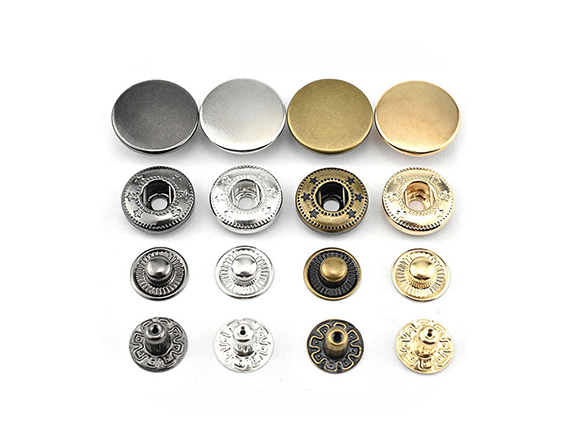
Base material selection dictates ultimate durability and aesthetic potential. Brass resists rust effectively but lacks ultimate tensile strength. Zinc alloy offers versatile 3D moldability but adds noticeable weight to the garment. Stainless steel dominates high-stress environments. You must specify premium stainless steel snap buttons heavy enough to withstand intense tension without deformation. High-tension environments destroy weaker alloys rapidly. Proper material selection forms the foundation of your custom fastener strategy.
Table: Base Material Comparison Matrix
| Base Material | Key Advantage | Primary Disadvantage | Best Application |
|---|---|---|---|
| Brass | High rust resistance | Moderate tensile strength | Outerwear and casual apparel |
| Zinc Alloy | Excellent 3D moldability | Heavier weight | Luxury apparel and custom logos |
| Stainless Steel | Maximum structural integrity | Harder to stamp | Marine gear and industrial workwear |
Exact dimensional tolerances matter immensely during production. Diameter affects visual proportion and user grip. Post length dictates fabric compatibility. Cap thickness determines crush resistance during the setting process. You must match post length precisely to your target fabric weight. Thick leather requires significantly longer posts. High-compressibility fabrics need careful tension calibration. Ignoring tolerances causes the fastener to pull through the material. Drafting precise buttons specifications early prevents costly tooling revisions.
Surface treatments go far beyond simple aesthetics. You must evaluate oxidation resistance carefully before approving mass production. Demand salt-spray test benchmarks exceeding 90 hours for outdoor gear. Colorfastness ensures dyes do not transfer onto the surrounding fabric. Poor plating flakes off after standard washing cycles. Specify exact micron thickness for metal coatings. Proper finishing ensures your custom hardware survives the entire lifecycle of the garment.
Custom molds require upfront capital investment. You pay for initial CAD engineering and precise CNC machining. This initial cost seems high compared to stock inventory. However, unit costs drop significantly at scale. You must calculate your break-even point accurately. High-volume production easily absorbs custom mold fees over time. Do not customize for a minor 500-piece capsule collection. Do customize when producing thousands of units requiring strict brand alignment.
Factories impose Minimum Order Quantities for custom designs. Typical MOQs range from 10,000 to 50,000 units. You must hold this inventory in your warehouse. It ties up working capital unnecessarily if mismanaged. Assess your storage capacity and overall cash flow. Some suppliers negotiate split shipments. This strategy mitigates inventory holding impacts. It allows you to pay for smaller batches while committing to an annual volume.
Machinery compatibility represents the most common failure point during assembly. Custom buttons rarely fit standard setting dies perfectly. You must ensure compatibility early in the prototyping phase. Your assembly line uses specific pneumatic or manual setting machines. Altering the cap dome requires completely new attachment dies. Using incorrect dies crushes the fastener during application. It ruins the garment and wastes expensive hardware. Always test prototypes on your actual production line equipment.
You need a direct manufacturer for complex custom projects. Avoid pure middlemen and trading companies. Assess their extrusion and stamping facilities directly. Direct ownership guarantees better quality control. It also accelerates troubleshooting when production issues arise. Ask for virtual or physical factory tours. A reliable manufacturer will gladly showcase their CNC machines and plating vats.
Trust requires verifiable data. Look for transparent quality assurance protocols. Reliable partners provide documented pull-tests for every batch. They offer metal composition reports upon request. They share structural integrity data freely. If they hesitate to share test results, find another manufacturing partner. Transparency indicates strong internal standards.
Time to market matters heavily in modern retail. Establish acceptable delivery timelines upfront. Standard CAD approvals take roughly one week. 3D printed samples take another week to arrive. Final brass or steel prototypes require two to three weeks for tooling. Delays in prototyping stall your entire production schedule. Agree on a strict timeline before paying tooling deposits.
Follow this actionable shortlisting plan to find a reliable buttons supplier:
The threshold for customization comes down to volume and structural necessity. Do not customize for minor aesthetic tweaks if your production volume remains low. Do customize when structural integrity, compliance, or core brand identity is at stake. The initial investment in molds pays off through reduced failure rates and elevated brand perception. We recommend initiating the process safely. Request physical samples of standard heavy-duty options first. Benchmark them against your desired custom parameters. Take these actionable next steps to begin:
A: Minimum Order Quantities vary significantly based on material choice and tooling requirements. Factories typically start between 10,000 and 50,000 units for fully custom molds. Stock items require much lower volumes, but custom designs demand higher initial runs to offset machine setup and calibration times.
A: The standard prototyping timeline spans roughly three to four weeks. You should expect one to two weeks for initial CAD designs and 3D printed molds. Following approval, physical sample production in the final metal takes an additional two to three weeks.
A: Sometimes custom caps fit standard sockets and studs. However, alterations to post thickness, cap dome curvature, or base structure will require new setting dies. Using incorrect dies crushes the fastener. It causes application failure and ruins the underlying garment.
A: Stainless steel is highly resistant to oxidation, but it is not entirely rust-proof. Specific metal grades, like 316L, provide maximum protection. They require proper finishing and plating processes to guarantee long-term performance in extreme marine or chemical environments.


