
Views: 0 Author: Site Editor Publish Time: 2026-09-06 Origin: Site


Specifying organic materials requires precise technical oversight compared to synthetic alternatives. Inherent variances in density, weight, and fragility mean you cannot treat organic closures like standard polyester. Specifying a natural button demands a careful balance of aesthetics and physical limits. Poor specification often leads to costly failures at scale. Incorrect thickness directly causes shattered closures during industrial washing cycles. Furthermore, incorrect sizing easily triggers buttonhole distortion or complete garment draping failure. We have developed a structured framework to prevent these manufacturing headaches. We will guide you through matching button dimensions—specifically Ligne and thickness—to exact fabric weights. You will learn how to align these metrics with your functional requirements and harsh production environments. By the end, you will know exactly how to document organic closures without risking structural integrity or production delays.
The apparel industry relies on a specific unit of measurement called the Ligne. We abbreviate this term simply as "L" in technical documents. One Ligne equals exactly 0.635 millimeters. This standardized system allows designers and manufacturers to communicate dimensions globally. Understanding this conversion remains critical for accurate production. You must convert Ligne to millimeters to program automated buttonhole machines correctly.
Different garments demand specific Ligne ranges based on tradition and function. Dress shirts typically utilize 14L to 18L sizes for standard front plackets. Lightweight cardigans might use 20L to 22L. Tailored jackets and heavy outerwear usually require much larger sizes. You will commonly see 24L to 32L specified for these heavy-duty applications. Choosing the correct Ligne ensures visual harmony across the garment front.
Standard Ligne to Millimeter Conversion Chart
| Ligne Size (L) | Millimeters (mm) | Typical Garment Application |
|---|---|---|
| 14L | 8.9mm | Shirt collars, cuffs |
| 18L | 11.4mm | Standard dress shirt plackets |
| 24L | 15.2mm | Trousers, light cardigans |
| 32L | 20.3mm | Suit jackets, blazers |
| 40L | 25.4mm | Heavy winter coats, outerwear |
While diameter uses the Ligne system, we measure thickness strictly in millimeters. We often refer to this measurement as the button profile. Standardizing this metric presents unique challenges for organic materials. Factories inject polyester seamlessly into identical molds. Organic materials grow naturally in unpredictable environments. They feature varying core densities and irregular surface curves. Milling these raw materials into perfectly flat blanks requires high-precision machinery. Even then, minor variances persist.
You must establish strict technical baselines early in the design process. Documenting exact natural button specifications prevents disastrous misinterpretations. A vague tech pack leads to flawed factory sampling. Quality assurance teams use digital calipers to verify these dimensions. Your tech pack must clearly state both the desired Ligne and the target millimeter thickness. Include acceptable tolerance ranges. We will explore those specific tolerances later in this guide.
Common mistakes in technical documentation include ignoring the lip or rim height. A closure might measure 2mm at the edge but only 1mm at the center. You must specify whether your thickness measurement applies to the rim or the deepest inner bowl. Clear visual diagrams inside your tech pack eliminate this confusion entirely.
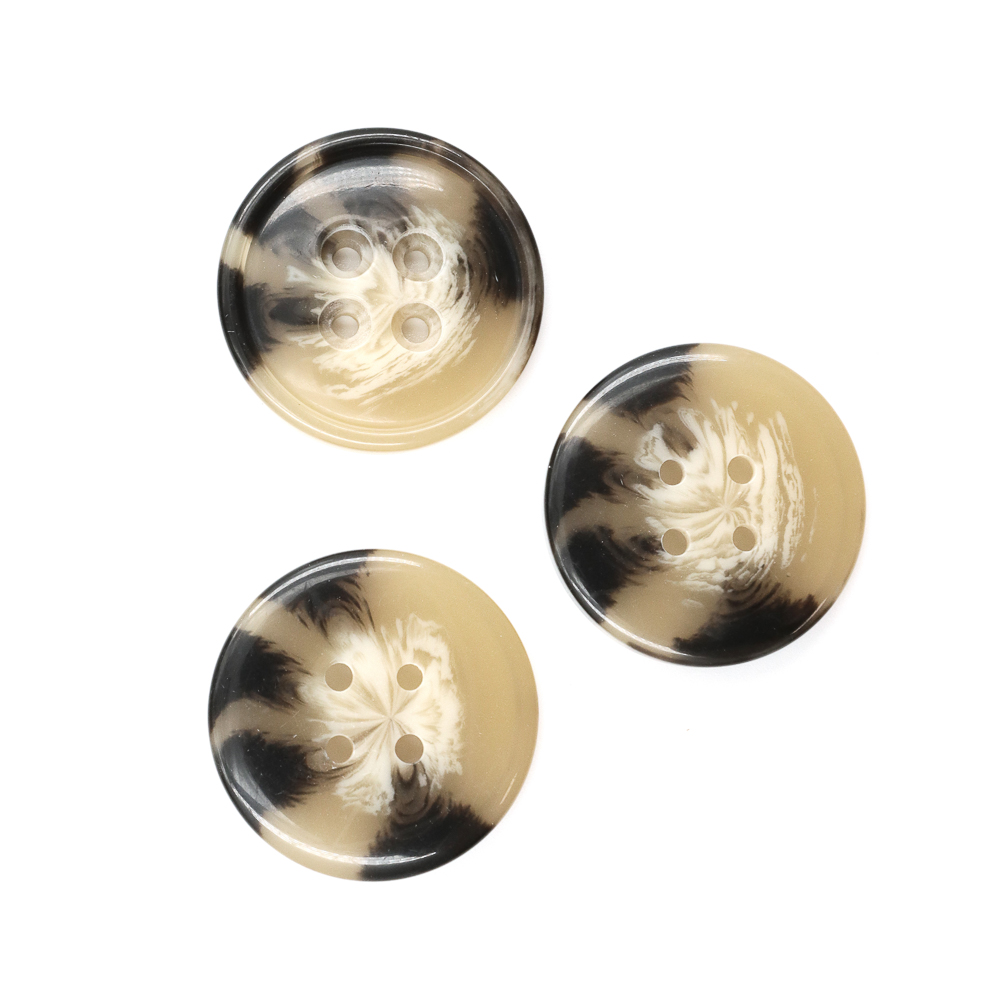
Physical realities dictate how you specify organic materials. You cannot ignore the cellular structure of natural elements. Each raw material possesses distinct breaking points and density profiles.
Shell materials include Mother of Pearl, Agoya, and Trocas. They look undeniably beautiful on luxury garments. However, shell possesses an inherent crystalline brittleness. It shatters easily under sudden mechanical impact. We highly recommend a minimum profile of 2mm for any functional shell closure. Commercial laundering processes are brutal. Machines tumble heavy wet garments against metal drums. Thinner shell profiles rarely survive this environment. High-tension buttonholes on tight garments also snap thin shells over time.
Horn and bone materials offer a completely different physical profile. Animals grow these materials to withstand massive impact. They boast incredibly high density. Their interwoven fibrous structures provide superior durability. You can safely specify slightly thinner profiles here without sacrificing structural integrity. A 1.5mm horn closure often outlasts a 2mm shell closure. Tailors favor thin horn pieces for bespoke suit trousers because they lie perfectly flat.
Corozo comes from the seeds of the tagua palm tree. Experts frequently call it vegetable ivory. It features an incredibly consistent internal density. You will not find the weak fracture lines common in shell. Corozo remains highly versatile across massive production runs. It serves as the ideal choice for standard mid-weight profiles around 2mm to 2.5mm. It carves beautifully and resists cracking under normal tension.
Wood presents the highest structural risk among organic choices. Olive, walnut, and bamboo carry unique vulnerabilities. They easily splinter along their natural grain lines under physical stress. Furthermore, raw wood absorbs water aggressively during washing cycles. Expansion and contraction eventually destroy the structural integrity. You must specify thicker profiles, usually exceeding 3mm. You also need to mandate edge sealing in your tech packs. Functional outerwear demands this extra protective resin coating.
Garment weight ultimately dictates your dimensional requirements. A massive size mismatch destroys the visual harmony of your design. More importantly, it compromises the physical drape of the fabric.
Lightweight fabrics require delicate handling. Think of fine silks, sheer cottons, and lightweight rayons. You must emphasize thin, lightweight profiles here. We recommend staying strictly between 1.5mm and 2mm in thickness. Heavy closures drag delicate fabrics downward. They cause ugly fabric pulling across the chest. Over time, heavy accessories permanently distort the natural drape of lightweight knits. Gravity always wins against loose weaves.
Mid-to-heavyweight fabrics handle stress entirely differently. Denim, heavy canvas, and winter wool require robust closures. Outline the need for thicker profiles exceeding 3mm. These heavy textiles create intense physical tension around the fastening point. A thin profile will snap under the lateral stress of a tight denim waistband. Thicker dimensions withstand daily structural stress effortlessly. They also provide better tactile grip for cold fingers operating heavy winter coats.
Fastening mechanics play a crucial role in your selection process. Buttonhole construction directly dictates your closure choice. When you utilize a standard sewing button 2 versatile fastening setup, you face a major decision. You must choose between a shank style and a flat-hole style. These two methods completely alter the required thickness.
Shank styles feature a hidden loop underneath. They push the main body away from the fabric. This creates necessary space for heavy woolen layers to sit underneath. Flat-hole styles pull tight against the placket. If you use a flat-hole style on thick winter wool, it compresses the fabric awkwardly. You must carefully calculate these mechanics to maintain proper spacing along the garment placket.
Follow these steps to ensure perfect fabric matching:
Scaling organic components introduces unique manufacturing risks. You must set realistic expectations for natural variations early in the process. Unlike synthetics, organic pieces will always display minor thickness deviations. Quality assurance teams cannot reject everything. You must establish acceptable QA tolerances before mass production begins.
A standard deviation of ±0.2mm serves as a realistic industry baseline. If your target thickness is 2mm, accept pieces between 1.8mm and 2.2mm. Tighter tolerances drive up material waste and production delays. Communicate this tolerance range clearly to your factory partners. They need this data to calibrate their attachment machinery correctly.
Machinery compatibility represents a massive hurdle. Automatic attachment machines operate using high-pressure pneumatic systems. Factory technicians usually calibrate these machines for durable polyester components. If they apply that same pressure to organic materials, disaster strikes. High-speed needles easily crush overly thin natural pieces. Irregular surface profiles cause frequent machine jams.
You must mandate machine calibration runs. Send a small batch of your chosen closures to the sewing facility early. Ask them to run these pieces through their automated hoppers. This simple step prevents thousands of shattered pieces on the main production line.
Evaluate laundering and lifecycle survival rates accurately. End consumers rarely follow care labels perfectly. Commercial dry-cleaning exposes closures to harsh chemical solvents. Some finishes on wood or dyed corozo might bleed under these chemicals. Domestic machine washing involves heavy mechanical tumbling. Agitators strike garments repeatedly. Thickness heavily impacts survival rates across both cleaning methods. Always wash-test your approved samples in commercial machines before signing bulk orders.
Sourcing organic components demands a rigorous vetting process. You need a partner capable of managing complex agricultural and manufacturing variables. Your final garment quality depends entirely on their internal grading systems.
Begin by auditing their consistency and quality control processes. How do they handle dimensional consistency across massive bulk orders? Ask about their sorting protocols. Premium factories use laser-guided sorting machines to group blanks by exact millimeter thickness. Manual sorting often leads to inconsistent batches. Inconsistent batches ruin your factory production timelines. You cannot afford irregular components jamming your automated sewing lines.
Assess their customization capabilities thoroughly. A basic vendor simply resells standard stock. A premium vendor offers custom milling. Can they perform precise edge beveling? Smooth, beveled edges prevent thread abrasion over time. Do they offer protective finishing options? As discussed earlier, wood closures require specialized resin coatings. Ensure they have the necessary dipping and curing equipment in-house.
Compliance and sourcing ethics remain non-negotiable. Organic materials carry significant environmental impacts. Look for specific industry certifications. Demand FSC (Forest Stewardship Council) certification for all wood products. This ensures sustainable harvesting practices. Request OEKO-TEX Standard 100 certificates to guarantee chemical safety in their dyes. If you source exotic shell or horn, demand CITES compliance documentation. CITES prevents the illegal trade of endangered species. Partnering with a fully certified natural button supplier protects your brand reputation globally.
Never skip the sampling protocol. Request comprehensive size and thickness runs before committing to any minimum order quantities (MOQs). Ask for ten pieces of each desired size. Measure them yourself with digital calipers. Test them on your actual production fabrics. Wash them harshly. Protect your bulk order investment through rigorous physical validation.
Specifying the perfect closure requires deep technical understanding. The right size and thickness represents a delicate balance. You must weigh your aesthetic desires against strict material physics and everyday garment functionality. You cannot treat organic materials like simple plastic commodities. Their natural beauty comes attached to strict physical constraints.
Take immediate action on your current technical documentation. Audit your existing tech packs today. Ensure every measurement includes both Ligne size and precise millimeter thickness tolerances. Reach out to your vendor and request a varied thickness sample set. Finally, rigorously test these pieces on your final production fabrics before you authorize any bulk ordering. Precision in the specification phase guarantees smooth, profitable production runs.
A: Simply multiply your Ligne measurement by 0.635. For example, a 20L measurement equals exactly 12.7mm. This standard conversion ensures your factory programs the automated buttonhole machinery accurately. Never estimate these dimensions. Precision prevents costly fabric puckering and fastening errors during mass production.
A: Thin shell closures face severe risks during machine laundering. They easily shatter against metal washing drums due to their crystalline structure. You must maintain a minimum 2mm thickness for basic durability. Always instruct consumers to turn garments inside out before washing to protect these delicate organic pieces.
A: Organic materials grow unpredictably in nature. Unlike injection-molded polyester, natural elements possess varying core densities and irregular curves. Milling machinery cannot perfectly standardize uneven raw blanks. Therefore, you must establish an acceptable tolerance range, typically ±0.2mm, to accommodate these natural manufacturing realities.
A: Yes, thickness heavily influences accurate buttonhole calculations. A correct buttonhole length must smoothly accommodate both the total diameter and the vertical height of the closure. If you specify an extra-thick profile without lengthening the buttonhole appropriately, the fabric will pucker and resist fastening.


